

You’re staring at a list of AS subjects, trying to figure out what to take. 9093 English Language looks appealing, or at least manageable. Before you make that selection, here’s what you should know. We’ll go through the big questions one at a time so that you can decide whether the 9093 credential is right for you.
Why take 9093 English Language?
First and foremost, 9093 English Language builds important reading, analytic, and composition skills. These are essential academic and life skills that allow you to excel both in and out of school. Think of it this way, you may never again use the quadratic equation or diagram chemical bonds, but strong reading and writing skills will serve you in every stage of life. This is no slight against maths or chemistry, which demand their own rigorous thinking. But few skills travel as broadly as reading and writing; whether it be drafting a term paper, reading a contract, or emailing with colleagues, strong English language skills follow you everywhere.
For the university minded, English is an important component of many fields of study such as law, marketing, public relations, media, education, and politics. Most professional careers require strong reading, writing, and communication skills.
Just as importantly, having the English Language qualification on your transcript communicates to Universities that you are capable of handling the demands of a university education.
Writing and reading are core components of just about every subject. Professors regularly assign readings from textbooks, published research, historical documents, and literature. Most also expect students to be able to effectively communicate their thoughts and understanding through writing, be it through formal modes, like a research paper, or informal ones, like an online comment. The 9093 qualification shows that you are ready for this type of work.
As a further benefit, for those looking to study internationally at an English language university, an AS or A Level English qualification demonstrates English fluency, and can often serve in place of a language proficiency test (such as the IELTS).
How difficult is 9093 English Language?
The 9093 English Language exam is challenging, and this surprises many students.
The jump from I/GCSE English to AS and A Level English is a big one. While English Language is one of the most passed IGCSE subjects, it is one of the least passed AS level subjects. Often, students who earned a B, an A, or even an A* for English on their GCSEs or IGCSEs find themselves struggling with the 9093 material.
As an AS subject, 9093 English Language stands out for its challenging nature. The graph below shows how the grade distribution for AS English Language compares with AS Accounting, AS Mathematics, and AS Chemistry, other commonly taken subjects. In the English Language, only 1 in 4 students scored a C or above, a proportion that is dramatically lower than in the other subjects. Add to that, just 4% of exam takers earned an A on the English Language AS exam!
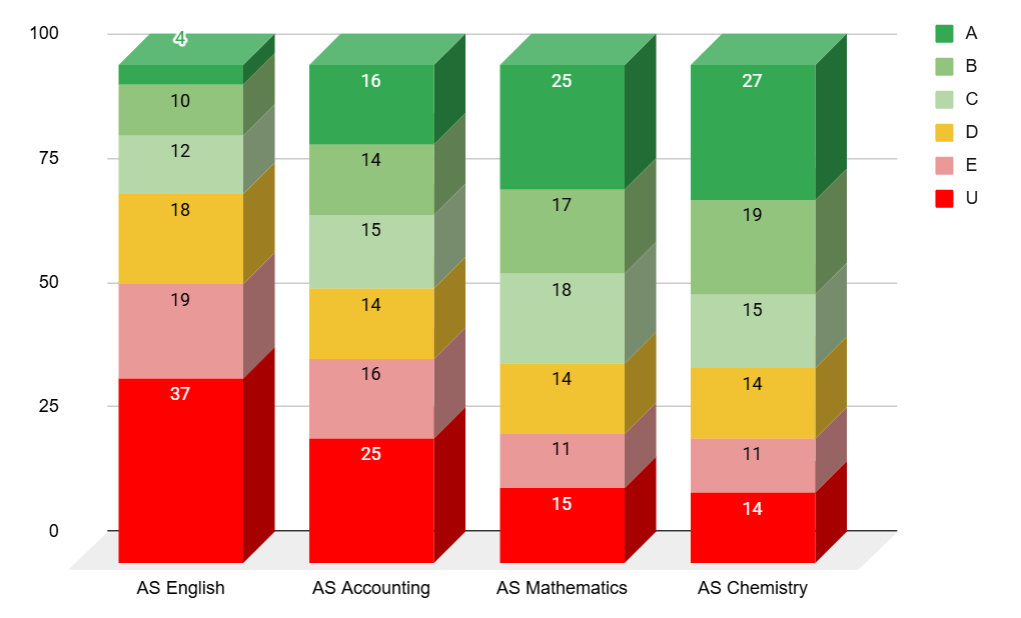
I point this out not to discourage you, but to prepare you. If you were considering English as an “extra” or “add-on” subject, meaning a subject that won’t require your full attention and effort, you might reconsider. On the other hand, if you are ready to put in a bit of effort, there’s no reason to shy away from 9093 English. With the right approach, the benefits will definitely outweigh the challenges.
Can I do well if I try?
Absolutely. The truth is, earning a C or above is within the grasp of just about any student willing to put in a little bit of work.
The recipe for success is simple: study, practice, and act on feedback.
By studying important concepts and terms and by reading in different text genres, you develop the base knowledge necessary for success. And by consistently applying that knowledge through practice and by acting on feedback, you build the skills and intuition needed to earn high marks on the exam.
If you can do these things, you stand a very good chance of doing well in 9093 English Language.
I took English as a Second Language for my IGCSE. Can I do well, too?
Yes, you can. I had a student who enrolled in my AS English class after finishing English as a Second Language for her IGCSE, and she earned a B on her AS English exam at the end of the year. So, it definitely can be done.
With that said, if you are coming from English as a Second Language, you may need to factor in extra time for your 9093 studies. And, if your IGCSE English marks were on the lower side, you’ll want to think carefully before committing to AS English.
How do I know if 9093 English Language is not for me?
When it comes down to it, your success in 9093 English Language really rests on three factors: your ability, your work ethic, and your circumstances.
Ability
While hard work can win the day, it’s important to take your natural abilities and past success into consideration as well.
When you put in an honest effort into your English work, how well do you do? Do you receive strong marks or do you struggle to get by? Your previous academic success is not a guarantee of success or failure in 9093 English Language, but it can give you a hint as to whether the subject will suit you.
Also consider your attitude about, and experiences with, reading and writing. Are reading and writing something you enjoy or are capable at, or do they serve as a constant frustration? Do you like the challenge of composing an effective essay or an engaging story, or do you cringe at the very mention of putting pen to paper or fingers to keyboard?
If you find that you have a true interest or decent abilities in the realms of reading and writing, then that’s a strong indicator that 9093 English Language may be for you. Conversely, if you realize that reading and writing have always been a source of frustration and failure, then you might ask whether the demands of 9093 English Language will truly set you up for success.
Work ethic
Socrates said, “know thyself,” and that’s good advice when considering 9093 English Language. Are you capable of consistently dedicating time and attention to your English studies? If so, then you stand a good chance of succeeding in this course.
If the answer is “no way,” then you have to consider whether the qualification is a good fit.
Circumstances
It may be the case that you enjoy English and are good at studying your subjects, but that you just don’t have the time or space in your schedule to put toward 9093 English. Sometimes students are already overloaded with other classes that they need in order to make them competitive for their university major of choice, and that’s okay.
English is a great addition to any field of study, but if other studies need to take precedence, it’s worth considering whether adding yet one more demanding course might just end up causing your performance to fall in all of your subjects.
Sometimes choosing not to take a course is the valid and sensible decision.
In conclusion
Ultimately, only you can decide whether 9093 English is the right fit. If you have a genuine interest in reading and writing, a willingness to put in the work, and the space in your schedule to do so, there’s every reason to take it on. And if you do, the skills you build will serve you long after the exam is over.

